

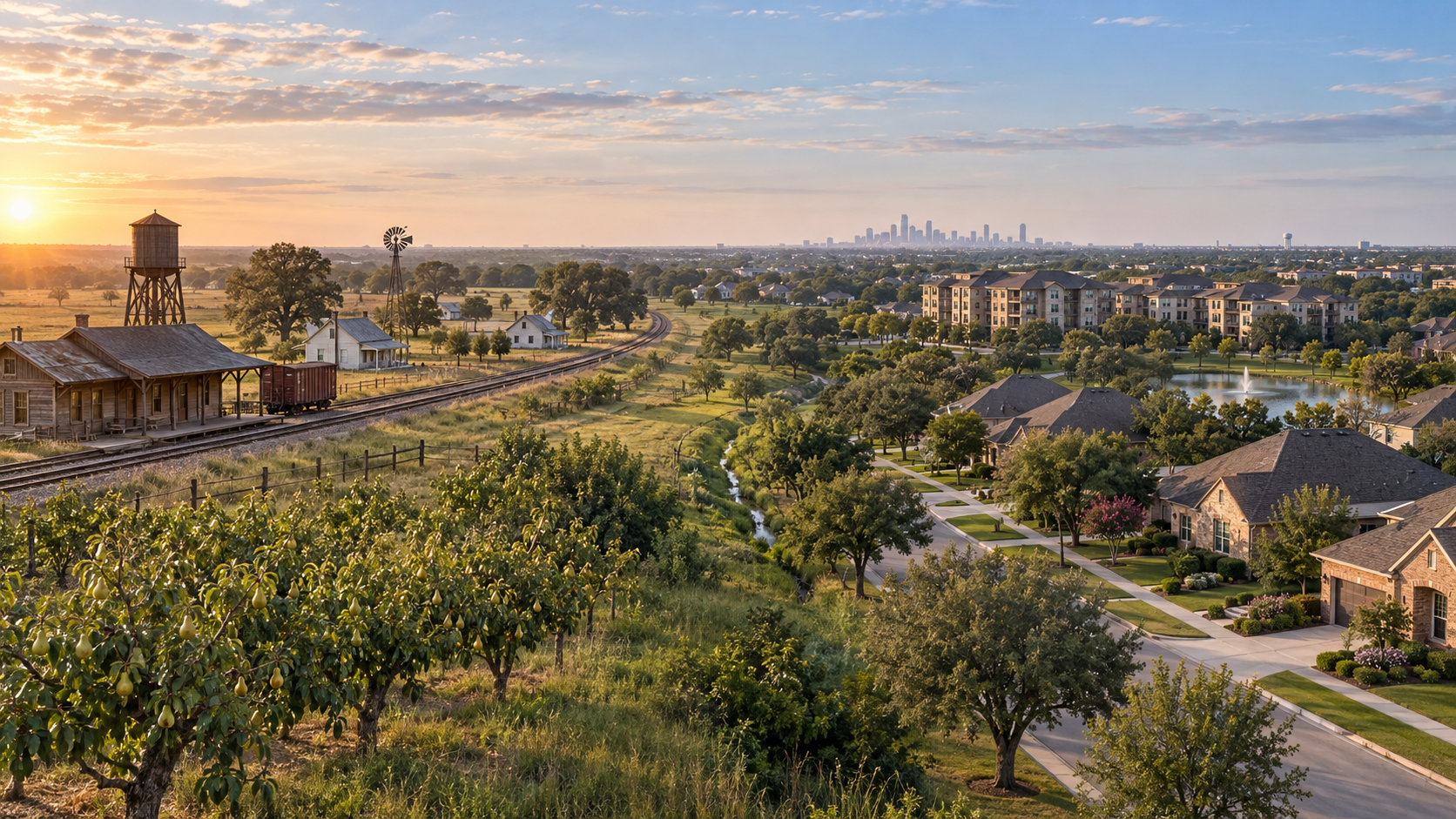
Pearland did not become one of Greater Houston’s most desirable suburban communities overnight.
Long before the master-planned neighborhoods, shopping centers, medical offices, and steady traffic along Broadway, Pearland was a small agricultural community built around the railroad. The town was renamed Pearland in 1894 because of the pear orchards growing in the area. By 1940, the U.S. Census counted only 30 residents. That number had grown to roughly 1,500 by 1960.
What happened next changed Pearland for good.
Houston expanded south. Employment grew around the Texas Medical Center. Highway 288 made the commute more practical. Families began looking for more space outside the city, and developers saw an opportunity to build the neighborhoods those families wanted.
Today, Pearland is a major suburban market with a real estate story shaped by rapid growth, changing buyer expectations, limited remaining land, and an increasingly important rental sector.
From a Small Town to a Houston Suburb
Pearland’s early housing market was exactly what you would expect from a small Texas town: modest homes, larger tracts of land, and development concentrated near the original townsite.
Growth remained relatively gradual until the second half of the twentieth century. As Houston’s economy and population expanded, Pearland became a logical place for families who wanted suburban living without completely disconnecting from the city.
The real acceleration came during the 1990s and 2000s. Communities such as Silverlake, Southwyck, Shadow Creek Ranch, Southern Trails, and other large developments brought thousands of newer homes to the area. These neighborhoods offered the features buyers were beginning to expect: community amenities, modern floor plans, nearby schools, and relatively convenient access to Houston.
The numbers show how dramatic that period was. Pearland went from 13,895 housing units in 2000 to 45,403 in 2020. According to the Pearland Economic Development Corporation, more than 9,500 single-family homes and approximately 3,000 multifamily units were constructed during the decade leading up to its 2023 demographic report. Pearland’s average home sale price also increased from about $194,000 in 2010 to more than $336,000 in 2021. (Pearland Economic Development Corporation)
That kind of growth changed what Pearland represented in the Houston market. It was no longer simply an affordable alternative south of the city. It had become a destination of its own.
Why Pearland Became So Attractive
Pearland’s location has always been one of its biggest advantages.
Residents can reach the Texas Medical Center, downtown Houston, Hobby Airport, and major employment areas without giving up the space and neighborhood setting many people want. Access to Highway 288, Beltway 8, and nearby employment corridors helped Pearland attract healthcare workers, professionals, growing families, and business owners.
Schools, parks, shopping, restaurants, and community amenities added to that appeal. As those services expanded, demand for housing followed.
But location alone does not explain the market. Pearland also developed a large supply of newer single-family homes during a period when Houston-area households were moving outward. Those homes gave buyers more square footage and newer construction than they could often find at a comparable price closer to central Houston.
The result was a market built largely around homeownership. Pearland’s 2040 Comprehensive Plan reports that approximately 74% of households are owner households. It also notes that more than 92% of the local housing supply consists of either single-family homes or large apartment communities. (City of Pearland Comprehensive Plan)
That leaves relatively little in the middle—duplexes, smaller multifamily properties, townhomes, and other housing types that can serve people who do not need or cannot yet purchase a traditional detached home.
This matters because Pearland’s next stage of growth will not look exactly like the last one.
The Development of Pearland’s Rental Market
For many years, renting in Pearland mainly meant choosing between an older apartment community and a privately owned single-family home. That market has become much more varied.
Much of Pearland’s apartment inventory was developed during and after the city’s population boom. A 2015 multifamily study found that 72% of the city’s apartment units had been built since 2000. At the time, Pearland apartments commanded a higher average rent per square foot than both the Houston metropolitan area and Texas overall. (Pearland Economic Development Corporation multifamily report)
Single-family rentals also became a much larger part of the picture. Some were purchased intentionally by investors. Others entered the rental market when homeowners moved but decided to keep their Pearland property.
That second group is especially important. A homeowner who purchased ten or fifteen years ago may have a favorable interest rate, meaningful equity, and a mortgage payment that makes holding the home attractive. Renting it can provide income while allowing the owner to retain an appreciating asset.
At the same time, today’s rental market is not automatic easy money.
Online rent estimates for Pearland can vary significantly because some platforms combine apartments, townhomes, and single-family houses into one number. Others report only active listings, which are asking rents—not necessarily the amounts tenants ultimately agree to pay. HAR’s Pearland market page currently reports an average rent above $2,500, while other rental trackers place the broader average closer to the low-to-mid $2,000s. (HAR Pearland Market Update, Zillow Rental Market Trends)
That is why a property-specific rental analysis matters more than a citywide average.
A clean, updated three-bedroom home with a functional floor plan, good access to Highway 288, and strong neighborhood appeal will compete differently from an older property with deferred maintenance or an awkward layout. School zoning, flood history, yard size, parking, pet policies, appliances, and time of year can all affect rent and leasing speed.
The market does not care what an owner needs the rent to be. It responds to what qualified renters are willing to pay for that particular home at that particular time.
What Pearland Renters Want Today
Pearland renters often want many of the same things buyers want: convenience, safety, space, good schools, and a home that feels well maintained.
The difference is that renters can move more easily when a property fails to deliver.
A rental home does not need every luxury upgrade to perform well. It does need to be clean, functional, competitively priced, and cared for. Reliable air conditioning is non-negotiable in this climate. Drainage, roofing, plumbing, and foundation conditions matter. So do everyday details such as secure doors, working appliances, usable storage, and a responsive maintenance process.
Renters also compare homes faster than they did in the past. They can see competing listings, pricing, photos, and neighborhood information within minutes. A property that is overpriced or poorly presented can lose attention almost immediately.
This is where some owners get into trouble. They look at the highest-priced listing in the neighborhood and assume their home should rent for the same amount. But listed rent and actual market rent are not necessarily the same. Holding out for an extra $100 or $150 per month can become expensive if it creates several additional weeks of vacancy.
Good rental performance usually comes from a combination of realistic pricing, professional marketing, careful screening, prompt maintenance, and a solid renewal strategy. No single piece can carry the entire investment.
A More Mature Real Estate Market
Pearland is now moving from rapid outward expansion into a more mature stage of development.
The city’s comprehensive planning process notes that much of the land within Pearland and its surrounding planning area has already been developed. New construction will continue, but future growth will increasingly include redevelopment, infill projects, and more deliberate decisions about housing density and variety.
Older areas of Pearland may also receive renewed attention. The city’s Old Town revitalization planning found that much of the area’s multifamily housing is older and earns lower rents than newer properties elsewhere in Pearland. That creates both a challenge and an opportunity. Aging properties need investment, but well-planned improvements can provide housing options that are difficult to create in newer master-planned communities. (Old Town Pearland Revitalization Plan)
For rental owners, a mature market requires more discipline. Investors cannot depend solely on rapid appreciation or constant population growth to make a weak purchase work. Property taxes, insurance, maintenance, financing costs, and vacancy all have to be included in the calculation.
A Pearland rental can still be a strong long-term investment. But the property has to make sense based on real numbers, not the best-case version of them.
What Comes Next for Pearland Real Estate?
Pearland’s fundamentals remain attractive. The city is close to major Houston employment centers, has an established community identity, and continues to offer the kind of housing many families want.
Rental demand should remain an important part of the market. Not every household is ready to buy, and not every renter wants an apartment. Some are relocating to the Houston area. Some want to test a neighborhood before purchasing. Others need flexibility but still want the space, yard, and privacy of a single-family home.
That creates opportunity for owners who understand the market and operate their rentals professionally.
The strongest properties will not necessarily be the newest or the most expensive. They will be the homes that offer the right balance of location, condition, functionality, and value. Owners who maintain those homes, price them accurately, and take tenant selection seriously will be in the best position to protect both occupancy and long-term property value.
Pearland has come a long way from its railroad and farming roots. Its real estate market has survived economic downturns, weather events, changing interest rates, and decades of growth. Through all of it, the city has continued to attract people who want to put down roots near Houston.
That history does not guarantee that every Pearland property will be a successful investment. It does tell us something important: this is an established market with real staying power.
At Realvest Property Management, we work with Pearland rental owners at every stage, from evaluating a potential purchase to preparing a former residence for the rental market. If you are considering renting your Pearland home or want a realistic look at what your property may earn, talk with us before making the decision. A clear rental analysis today can prevent an expensive assumption tomorrow.